Mostrando entradas con la etiqueta Egipt Presidential Election. Mostrar todas las entradas

jueves, 21 de junio de 2012

Now it's done! Egypt's political instability and the danger of a long and hard "transition"...


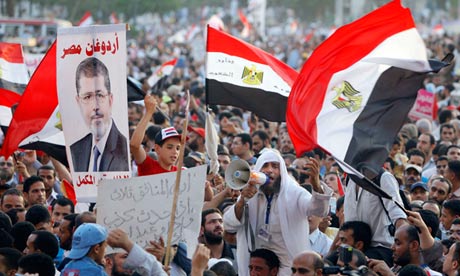
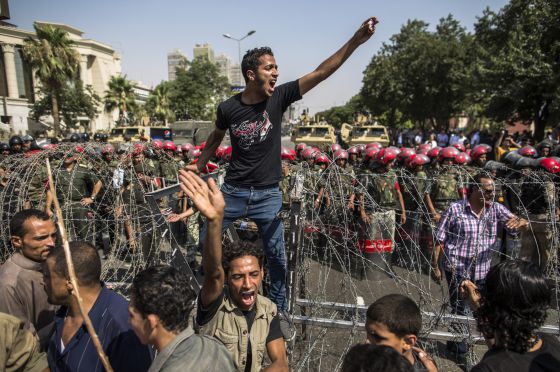
I was surprised (again!!!!) with the electoral results in Egypt last sunday. By unofficial results, the muslims brotherhood would win with 52% for their candidate Morsi, against Shafiq (last Mubarak's Prime Minister) with 48%. But, on this Thursday the Junta denied to declare the official results and Cairo is now under strong protests. Thousands and thousands of people went to Tahrir square to claim their power in front of the army. At the same time, it started to rise many histories about Mubarak's health, what deepens even more Egypt crisis.

We don't know what's really going on with Mubarak, neither with the election results. But one thing  it's beginning to be clear... Army in the parliament, declarations about the unconstitutionality of the electoral law, and the denial to declare the official results... for me, can be everything, less then a political transition for the democracy... unfortunatelly...

viernes, 15 de junio de 2012

And what we feared... maybe can happen...


By now I confess that I was satisfied with all the results of the political transition in Egypt, but maybe the things started to change, not in a democratic direction...

On Wednesday the Constitutional Court declared unconstitutional the electoral law, what means that the new Parliament formed just some months ago is invalid. Before the electoral law stated that 2/3 of the Parliament should be elected through electoral lists, and 1/3 should be individual candidates. Nevertheless, there was an agreement to amend the law, which established that these individual candidates should be a member of some political party. Now, the Constitutional Court declared that this agreement is unconstitutional, because it was an obstacle for independent citizens to be elected. After, the Court determinated the nullity of the elections and the dissolution of the Parliament.

The second law declared invalid by the Constitutional Court is one which stated that members and officers of Mubarak's government couldn't be candidate for a presidential elections. This means that Ahmed Shafiq, Mubarak's supporter could be the first president elected "democratically".

With the dissolution of the Parliament... the army took over the place... and the people don't know exactly what to do. Some activists are planning to claim to the people not to vote, others are trying to make another revolution (but with the new antiprotests laws, many are afraid of it), and others are getting prepared to vote in Shafiq...

What do I think? I think that Egypt's future is being written, and the horizon might be not so good...

PS: Unfortunatelly I can't read arabic, that's why I don't know exactly the terms of the sentence. But I tried to find it... I couldn't find it and it was not a surprise...

martes, 5 de junio de 2012


Egypt and the distrust in the democracy

It is totally natural that the egyptians don't trust in these new democratic procedures to elect the next president. After so many years under Mubarak's command, it takes some time and it is quite acceptable the new popular movements which are taking place now in the country to argüe it.

Three losing candidates from the first round of Egypt’s presidential election say there were widespread irregularities in last month’s vote.

I can't say anything about second round's candidates (although the fact that, in my opinion, it's kind of strange to have Mubarak's supporters in it), but maybe I could ask if is legal or lawful trying to cancel the first round results just to investigate this. We had some suspicions about the procedures before, but it was removed in the first moments of the elections.

The worst thing which could happen now in Egypt is to extend more this democratic transition with no formed government. Considering that all candidates's appeals were refused by the Court, it's really difficult to accept some demand like this one.

sábado, 2 de junio de 2012

Egypt, presidential elections and Mubarak - a complete contradiction


Some weeks ago I wrote here about egyptian elections, and I emphasized the possibilities of a Mubarak's candidate get elected. It's not a direct candidate, but now in the second round the egyptians have to choose their president between Ahmed Shafiq (the last Mubarak's Prime Minister) and  Mohamed Morsi, member of other muslim movement with strong social support.


This might become Egypt totally polarized and, now in the beginning of the transition, in my opinion this is not good. But democracy is democracy and what people decide, is decided.


For me there's other thing which made me think.... how can be possible to have a candidate who was connected with Mubarak in the second round, and the people celebrate Mubarak´s life sentence?


This sentence was not enough for thousands of Egyptians who poured onto the streets after the verdict. Some wanted Mubarak executed, others feared the judge's ruling exposed weaknesses in the case that could let the former military strongman off on appeal. But, at least for me, this is really contradictory.


Anyway, that's how democracy works, right?

miércoles, 18 de abril de 2012

The "warm up" for Egyptian presidential election.

For some months now, the world has been following Egypt's political transition with attention. After intense moments of armed conflict, treats of civil war, many victims and a real demonstration of virtual mobilization, Egypt now prepares itself for it's first democratic presidential election for years.

Surely this process will not be easy. As many dictators, Mubarak has supporters who are trying to get into the new government. On the other hand, it's very complicated to organize a fair election when the country is divided into many fractions (these go much further than the religion), and to unit this by law and by principles of democracy is not that simple.

An example of this is the last decision by the country's supreme election commission to bar 10 candidates from the electoral race, including the controversial candidate of Muslim Brotherhood, Khairat Al-Shater (number 2 after Mubarak), the popular salafi Sheikh Hazem Abu Ismail, and the former intelligence chief in the Mubarak era, Omar Suleiman. They were the three leading candidates.

Their candidacy were not considered for different reasons. On the one hand, Al-Shater was barred because of his political disqualification of 7 years for being an ex convict. He received a secret amnesty of the military commission, but the election commission considers that it's not valid and it should be given by a court. On the other, Abu Ismail can't be a candidate because his mother had a double citizenship before her death, and this violate the rule that no candidate can have a spouse or relatives with double citizenship. In Suleiman's case, 31 signatures was missing in the province of Asiut to have the 30.000 needed to present a formal candidacy.

Although the fact that all the candidates will appeal this decision, it's not possible to demand in the ordinary court against the electoral commission's decision. That's why it can be considered as a final decision.

After this change in the electoral landscape, the bans leave a less controversial field to contest the 23-24 May presidential poll. Amr Moussa, a former foreign minister and ex-head of the Arab League, is neither supported by the Islamists nor by revolutionaries, nor is he particularly close to the military commission. This distance from all parties could make him a compromise figure. His strongest competitor is Mohamed Morsi, which is not a well-known figure, but will have the full backing of the Brotherhood, which together with Islamic conservatives won more than 70% of the seats in parliamentary elections earlier this year. Moreover, there's Abdel-Moneim Abul-Futoh, who is a former Muslim Brotherhood member who was expelled when he decided to run for president at a time when the group had stated it would not field one. He is a consensus figure due to his Islamist background and his pro-revolutionary stance. He also has the support of many liberals for his moderate religious stance and his insistence on equal rights for all citizens, regardless of religion or gender. However, the Brotherhood seems dead set against him winning.

Now we have to wait, because this is only the first big controversy in Egyptian politics. There is still the draft of the Constitution...